This letter is from Homeschoolfreestuff. I really can't picture myself 18 years from now but after reading this letter, I hope that we will too be another homeschooling success story. =D
Words of wisdom from an 18 year veteran!
We have been home schooling now for over 18 years and have had challenges and successes along the way. Let me share a few of the things we find successful in making our home atmosphere more conducive to learning.
1. Keep a smile on your face~ it is contagious.
2. Be up and dressed before your children. (This necessitates going to bed at a decent hour!) How hard this can be when the only quiet time you may have is after the children are in bed.
3. Spend at half an hour a day reading something you like~this accomplishes two things~It gives you a time to enjoy a book and it sets the "reading is fun" example for your children. Make sure that your children honor your "alone reading time" by establishing gentle rules for respect of your time. Perhaps there is some task you may set for them when you read alone. If they are little tell them that after you have your reading time you will spend time reading aloud to them.
4. Have a morning and evening routine and set aside enough time to complete the routine without rushing. Build in a few minutes of "Opps" time. Creating a smooth morning and evening routine in which children can gradually increase their autonomy is very important to their growth and development into responsible youth and adults.
5. Sharply limit television watching. We don't watch it at all during the week and don't encourage it on the weekend. There are many studies about the effects of TV watching (even good shows) on brain waves. It is a completely passive activity requiring little brain processing. Instead encourage physical activity. This increases metabolism, brain functional ability (thinking), and creativity. Do exercises or physical activity with your children.
6. Have frequent family time. We set aside one evening a week for games, fun family activities and just to talk. We try to plan creatively so that it is exciting. One cold winter evening we "went camping and enjoyed a campfire" by clearing out most of the living room furniture, pitching our tent facing towards a blazing fire in the fireplace, toasted marshmallows and sang songs. It is something we all fondly remember to this day. Even our married daughter!
7. Keep a "date night" with your spouse once a week. THE most important thing you can do for your children is to love and respect your husband/wife. Show affection and appreciation for your spouse everyday. If that is not happening now, make it happen. Remember the things which attracted you to your mate and overlook those small shortcomings. They will then overlook yours! A good trade off!
8. Always begin with the end in mind. Think, "What is it I want to accomplish and what is the first step to reach that ultimate goal"?
9. Don't yell.....if you do then someone else is in control!! Instead of conditioning your children to respond after you scream, condition them to respond to a very lowered voice. To do this set the rules and follow through the very first time the rule is broken. They learn quickly with consistency!
10. Keep learning. Always have something you are studying, even if but for 20 minutes a day. That totals over 2 hours weekly! Keep your mind alert.
~D.S.~
Thursday, July 12, 2007
PUZZLE
I got this puzzle for Ethan so he could study the rooms of a house. He really loves puzles so I thought that this would be a great learning tool for him. At first, he needed help in putting the puzzle pieces together. But later on, he got it and now, does not ask help from me. =D


The garage.

Here's the puzzle.

The garage.

Behind the front door.

LESSONS
The other day, Nikki answered his workbook and we tackled different things like arts and crafts, picture sequence, things that do not belong, things that go together, finding the differences, and tracing curves. I really loved that workbook because Nikki did several lessons at once and so, it was not boring for him and he really enjoyed the cutting and pasting.
Here are some photos:

Nikki found all the tools (things that did not belong). He found a thimble but didn't know what it was for. When I told him it was used on the thumb to prevent pricks while sewing, he realized that it did not belong in the parlor. =D

This one was easy for him.

Nikki enjoyed this activity because of the cutting and pasting. After we did this, I thought that we should do more of this type of activity to let Nikki practice his fine motor skills. Besides, he really loves doing it. =D
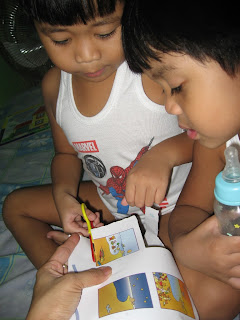
Here's Nikki cutting with his cute red and yellow scissors. See his mouth? It's crooked in concentration. Ethan watches closely. =D

The finished page. Of course, he had to explain to me the whole story.

Looking for the differences. Nikki found them all without any help from me.
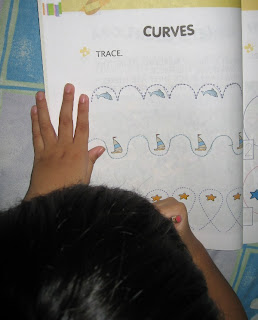
Following the broken lines. Nikki does not like this exercise too much so we do it sparingly.
Here are some photos:

Nikki found all the tools (things that did not belong). He found a thimble but didn't know what it was for. When I told him it was used on the thumb to prevent pricks while sewing, he realized that it did not belong in the parlor. =D

This one was easy for him.

Nikki enjoyed this activity because of the cutting and pasting. After we did this, I thought that we should do more of this type of activity to let Nikki practice his fine motor skills. Besides, he really loves doing it. =D

Here's Nikki cutting with his cute red and yellow scissors. See his mouth? It's crooked in concentration. Ethan watches closely. =D

The finished page. Of course, he had to explain to me the whole story.

Looking for the differences. Nikki found them all without any help from me.

Following the broken lines. Nikki does not like this exercise too much so we do it sparingly.
Wednesday, July 11, 2007
PRESCHOOL
http://www.besthomeschooling.org/articles/bev_krueger.html
Preschool Homeschooling
Bev Krueger, Creator of Eclectic Homeschool Online
Eager to begin assisting their children down the path of life many young parents schedule play dates, attend Mom and baby swim classes, and busily start planning all the necessary activities to give their baby a head start in life. At this early date they haven't yet realized they are trying to speed their way to the moment when that beloved child leaves their door for a life on their own. Yes, that's a moment all parents want their children to achieve fully prepared for the vagaries of life, but the closer you get to that moment the more time you wish you had. By the time your child is sixteen, you find them running willy nilly towards that goal themselves just when you're ready to relax and take it a little slower.
With children ages five through sixteen, I've been through the new parent "over achieve for my child" period and now face the "my baby is going to be leaving soon" period. It's mingled heart ache and joy. The way I deal with my younger children is also greatly affected by this new life stage. I've started slowing down with them already. Rather than push them on to new achievements ahead of the pack, I'm giving them more time to be the age they are. Rachel needs plenty of time to play house, sing to her dollies, color, dress up, and create play dough buffets. She'll give up all these activities soon enough, but the timing will be her own, not because I have pushed her into more "educational" activities.
The concept "educational" activity is in itself restricting. Somewhere along the way we have lost the understanding that the activities commonly known as "school" are only one form of educational activity. Learning to read, write, and do arithmetic have been elevated to such a high plane that the other forms of learning are pushed to the side as unworthy of much dedicated time. In the past preschoolers were not expected to learn to read; and yet today I receive many requests for help in choosing a reading program for three or four-year-olds. I'm assured that the child is more than ready to take this next step in his educational program. That may well be, but my response is "so what?" Assuredly you can start a reading program that requires only 10 minutes a day, and that really isn't a great chunk of time to whittle out of the child's daily schedule. But most people that insist on starting their preschooler reading are also working on math, doing science experiments, and finding all kinds of ways to jumpstart academics. All this "educational" activity pushes aside the things that a child should be doing, playing, exploring and discovering life on their own.
Most parents would be horrified to realize that they may be unintentionally quashing their child's creative abilities by constantly employing them in directed activities. They teach them to color in the lines rather than give them art supplies to use as they decide. Rather than letting them discover ants on their own, they take them outside for a complete lecture on ants. By the age of two, they schedule regular dates for their children to play with those their own age ignoring the fact that two-year-olds don't yet play socially. They tie up all their time in planned activities and events never allowing children the freedom to discover on their own. Creativity needs room to experiment. If children have no room to do their own thing, they will gradually stop thinking in creative ways and look only for the "correct" or "proper" way to do something. They will turn to their authority, the parent, to tell them what they should do. Later in life they will turn to other authorities.
Admittedly the over-achieving parent I've described is not the norm. But most of us would recognize those traits in ourselves to one degree or another. If you're naturally given to a relaxed mode of life, don't pat yourself on the back too hard. Everyone has flaws - it's just the organizers in life that fall prey to this need to organize their children's lives to the nth degree.
So what should an over-achieving parent do besides sitting on their hands and screeching occasionally? Organize their children's things. No, I don't mean sort out their closets. I mean actively plan what things you will place in your child's environment. Surround your child with the tools for creative play: blocks, puzzles, dress up clothes, dolls, cars, trucks, toy dishes, stoves, sinks, and brooms. Be discerning in the toys you select. Are they toys that stimulate imaginative play? Avoid electronic toys. Have bins of art supplies, science supplies, and craft supplies that children can access and use as they desire. If you have room, provide a stack of planks, bricks and boxes for outdoor construction projects. Let your children raid the linen closet to create their own tents with the dining room table. Help them string a clothesline to hang curtains for stage productions. Provide plenty of music tapes and an easy to use tape recorder. Children will use these tools to build on daily experiences and those special occasions when they make a visit to the zoo, museum, or children's show. The day after their big sister's car wash you may find them outside pretending to run their own car wash for all the tricycles in the neighborhood. A visit to the zoo might spark the creation of their own jungle room using their stuffed animals.
Allow children plenty of time to do their own thing. Turn them loose in the back yard to dig, poke and pry keeping an eye on them from a distance. I promise when some momentous discovery is made they will come charging back to you to share it. As much fun as it is spending time doing things with your children, it is equally fun to watch them busy at their own tasks. Surreptitiously observing your children will give you priceless memories of inquisitive faces determining that water runs down hill if you dump your pail out on a sloping yard. That hands on experience and many others will later confirm the concept of gravity when they are older.
Don't let what I have said cause you to react too far in the other direction and avoid doing things with and for your child. Many things that children learn are learned by observing and following another's example. When you're baking include your children. When you're folding laundry let them help. Suggest that your daughter get out her ironing board and iron while you iron, too. Give your son a patch of ground to grow his own flowers from seed, showing him how to cover each seed with just the right amount of soil and then gently sprinkle them with water. The daily flow of life in a household is another of the "educational" arenas that is forgotten in todays society. Playing house is one of a preschool child's delights. It gives them the opportunity to practice all the tasks they have seen their parents and older siblings do each day. Although they may not accomplish a task as perfectly as you desire, their unabashed enthusiasm for housework will never be greater than at this age. Letting them help you will teach them far more than you imagine. They'll be improving their large motor skills, learn to discern subtle differences (this window is clean, this window has streaks), and learn to order tasks properly. All these things will help them later when they do finally learn to read.
Don't rush your child through their childhood because you think you are giving them a head start on achieving great things. Academics have their place in a child's education, but they shouldn't be allowed to force out the other important learning that a child needs to do. As parents we want so much for our children that sometimes we push them when it's better to let them grow at their own pace. The key is to relax. Relax, that's a word that you will hear throughout your homeschooling career. Even after many years of homeschooling and parenting I still find myself needing to be reminded to relax occasionally. It's hard to imagine now at the outset of your journey just how much you will miss the times when your children came trouping out in oversized shoes and clothes to invite you to a tea party in their room. Revel in this time. The future holds equally wonderful treasures, but they will be different treasures.
Tuesday, July 10, 2007
MIRROR ART
This is one fun activity we all love. The boys love it because it is fun and colorful and they can be as creative as they want. And I love it because it's not messy at all. All the boys have to do is press the watercolors out of the tubes straight onto the paper. No water, brushes, no fuss. Nikki loves it because it doesn't get his hands dirty (he is very obssessive-compulsive although sometimes he does get some paint on his fingers and he would rush to the bathroom to wash his hands). Ethan loves it because well, it's art and Ethan is very artistic. The boys love the surprise that comes after they press the paper down. We were supposed to do only 4, but Ethan wanted more. So we did 6. And then we ran out of water colors. =D

Here is Nikki with their second art work. (Wasn't able to take a photo of the first one.)

Nikki shows me their next work while Ethan gets the watercolors ready.

Ethan loved this one. After he opened it, he cooed, "wooooooooow!"

The brothers check out their final work while Ethan makes some comments.

Their beautiful artworks. =D
Monday, July 9, 2007
WORKBOOK

My sister bought this workbook for Nikki. Unfortunately, it is too simple for Nikki so I just used it as a reviewer for him. True enough, in only 2 nights, he finished answering the book. But he really enjoyed answering it. But he loved getting those gold stars most of all. He told me, "Mommy, they look like the stars in Mario Bros." Oh boy... =D


RECORD-KEEPING
http://www.thehomeschoolmom.com/gettingorganized/000049.php
Record-Keeping & Organizing:10 Reasons to Keep Records
by Barbara Edtl Shelton
BE PREPARED AND ORGANIZED - in how your home operates and in presentation of lesson work on a daily basis. You're on top of it, not it on top of you! Helps you prepare for the academics you want to teach; have materials on hand for creative projects that you OR the kids initiate.
DOCUMENTED EVIDENCE "Something to Show" ...that "education" is taking place. Who would want or have good reason to know this? College? Grandparents? School officials? Legal/Court? Applying for a scholarship? ... I testified in a court case that made me feel very thankful I had kept good records, but not everyone will need this
SHOW 'N' TELL - Show other homeschoolers what worked (or didn't work) for you and your kids. Newer homeschoolers like (and are wise) to learn from the experience and mistakes of those who have done and are doing it.
NOSTALGIC VALUE - Records of this nature enable you to hold onto memories, parents' or kids', giving you something to reminisce with in years to come. Appealing to those of us who are "historians" at heart!
BRAIN UNLOADER - I need to get my accumulating ideas, thoughts, and goals OUT of my brain and ONTO paper, or I carry around the annoying weight of having to TRY to remember them which I seldom ever CAN! This is a great burden-lifter for me; unboggles my mind, freeing it up to move onto other things!
DISCERN & EVALUATE PROGRESS - This type of tool helps you see where you've been and what has been accomplished and mastered so you can re-evaluate where you're going and what to do next, what to emphasize, and what to eliminate.
DIRECTION and VISION - See and know the overall picture of where you're headed; what you want your child to walk out your front door equipped with and prepared for. Of course, this must align with God's plan for your child's future, how He wants to use him and his unique giftings.
PRIVILEGE-REGULATOR - A way to balance privilege with responsibility, to have "gentle accountability." Especially helpful if you have more than one child and it's hard to "keep track."
GLEAN MORE FROM REAL-LIFE SITUATIONS - The "Learning Guides" I have designed are to help you direct your student to get more out of real-life learning experiences, lessons, or activities. They can be wonderful records of real-life-related work done by your child. (See The Booklet Building Book and Section IV of Senior High: A Home-Designed Form+U+la and Section IV of Lab Science: The How, Why, What, Who, 'n' Where Book)
PORTFOLIO MATERIAL - These are items that can be part of or included in a creative, well-presented, well-rounded portfolio. You want it to represent your student's progress, accumulated knowledge, and/or expertise in a particular area.
Copyright by Barbara Edtl Shelton.Used by permission from the author.
The Sheltons operate a home-based ministry to homeschoolers from their home in Longview, WA, primarily through the books that Barb has written. All of Barb's speaking and writing is on topics of vital interest to burning-out as well as brand new and wanna-be homeschoolers. Barb's resources reflect her "lite" approach to homeschooling that is based on the verse in Matt. 28:11 in which Jesus says "My yoke is easy, my burden light." With vulnerability, humor, God's Word, Barb's heart is to inspire parents to pursue God's unique plan for the education of their children, and she offers much practical help in doing so. You'll be challenged, irritated, and moved to laugh, cry, think and re-think your views about education, and best of all, get set free (or freer) in Jesus! They may be contacted via their website:
http://www.homeschooloasis.com/
Sunday, July 8, 2007


KEEPING RECORDS
http://homeschooling.about.com/cs/recordkeeping/ht/htrecords.htm
How To Keep Records For Your Homeschooled Child
From Beverly Hernandez
It is important to keep good records of your child's homeschooled years. Stay on top of your record keeping so that if you ever decide to put your child in school, everything will be in order.
Time Required: 2 hours
Here's How:
How To Keep Records For Your Homeschooled Child
From Beverly Hernandez
It is important to keep good records of your child's homeschooled years. Stay on top of your record keeping so that if you ever decide to put your child in school, everything will be in order.
Time Required: 2 hours
Here's How:
- Check to see if your state has specific record keeping requirements.
- Obtain your child's cumulative file from the public or private school they previously attended.
- Begin keeping a cumulative file or portfolio if your child is just beginning school. You can use a regular file folder or purchase a cumulative file from a school supply store.
- Keep a course of study form on file for each year. A course of study is a list of the subjects that will be taught and what materials will be used to teach each subject.
- Keep you child's health and immunization records in the cumulative file. Contact your local health department for the necessary forms.
- Attendance records are typically required. This can be accomplished by keeping a calendar of days your child "attends" school.
- It is helpful to keep a record of the child's progress in each subject. You can do this as a progress report or a report card.
- If your child is high school level, you'll need to begin a high school transcript.
- Keep samples of your child's work.
- You might also like to keep a record of books your child has read.
Tips:
Most support groups provide the forms necessary for record keeping.
It's easier to do your quarterly progress reports and/or report cards if you keep a daily journal of some sort.
Record keeping doesn't have to be complicated. Simple records are fine, just be consistent.
Saturday, July 7, 2007
ROAD ART

Here's Nikki with some of the neighborhood boys. The one on the left is my cousin's kid, the one in the center is a neighbor's and Nikki is on the right. They really had a lot of fun drawing on the ground. =D

Some of their drawings (but I drew the hopscotch because Nikki had no idea how to do it). Too bad I was not able to take a photo of the other drawings. =(
Subscribe to:
Posts (Atom)
